
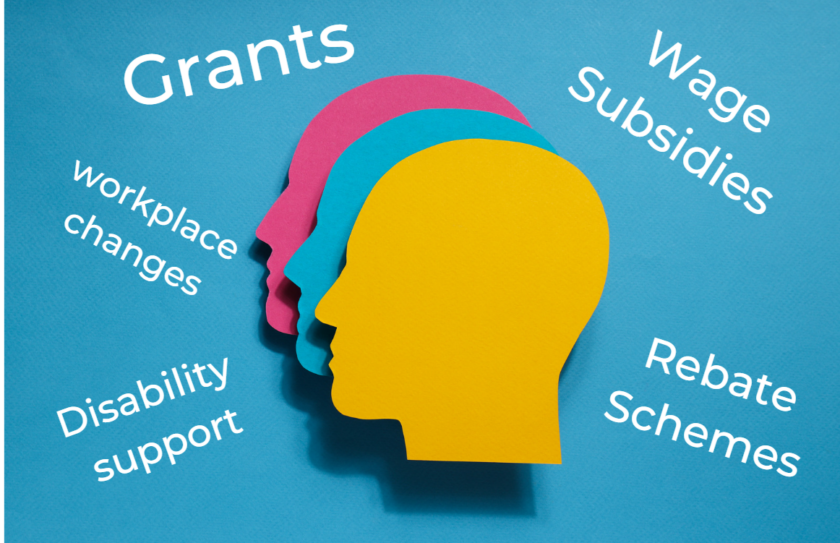
Finding and retaining the right people remains one of the biggest challenges for Australian businesses. To support employers, a range of government incentives and wage subsidies are available to encourage employment, workplace inclusion, and return‑to‑work outcomes.
These programs are designed to reduce the cost and risk of hiring, particularly when employing people with disability, those returning to work after injury, or job seekers who may need additional support.
Below is an overview of key incentives currently available, along with what employers should consider when evaluating them.
Please note: Government programs, eligibility criteria and funding amounts are subject to change. This information is current at the time of writing, and advice should be sought to confirm eligibility before relying on any incentive.
1. WorkSafe Incentive Scheme for Employers (WISE)- Employer Incentives and Return‑to‑Work Support
In Victoria, WorkSafe Victoria administers a range of programs that support employers to:
- Offer employment to workers unable to return to their pre‑injury employer
- Participate in return‑to‑work initiatives
- Improve mental health and recovery outcomes in the workplace
Rather than operating as a single static scheme, WorkSafe regularly updates its employer incentives and grant programs based on policy priorities and funding rounds.
For employers, this means:
- Incentives may be available, but eligibility will depend on the worker, role and business structure
- Payment structures and conditions vary
- Programs evolve over time
Best practice is to treat WorkSafe incentives as part of a broader employment and workforce strategy, not a standalone decision.
🔗 Employers should refer to the WorkSafe Victoria website for current programs and guidance.
For more information, refer to the WorkSafe Incentive Scheme for Employers – Program Overview.
2. Workforce Australia: Wage Subsidies and Employment Support
At a federal level, Workforce Australia administers employment services and employer support programs, including wage subsidies.
These subsidies may be available when hiring eligible job seekers and are designed to:
- Offset initial employment costs
- Encourage ongoing employment
- Support priority cohorts in returning to work
Important points for employers:
- Wage subsidies are not automatic
- Amounts, duration and eligibility depend on the specific job seeker and role
- You generally cannot access multiple subsidies for the same position
- Certain arrangements (such as family employment or contractor roles) may be excluded
Rather than focusing on a fixed dollar amount, employers should assess whether a subsidy applies to the specific hire under consideration.
🔗 Current details are available via Workforce Australia for Businesses.
For more information, visit the Workforce Australia website.
3. JobAccess: Workplace Adjustments and Inclusive Employment
Through JobAccess, employers may be able to access support to create inclusive workplaces for employees with disability.
Support may include:
- Workplace modifications
- Adaptive equipment and technology
- Communication services
- Mental health and learning support
- Disability awareness training
These supports are assessed individually and aim to remove barriers to participation and enable employees to perform their roles effectively.
Support may be available through the Employment Assistance Fund (EAF), which can assist with workplace modifications, specialised equipment, Auslan services and other workplace supports.
For many businesses, JobAccess support complements broader diversity, equity and wellbeing strategies.
For more information, visit the Job Access website.
4. Disability Employment Services and Inclusive Employment Support
Disability Employment Services and Inclusive Employment Australia providers can help connect employers with candidates with disability and provide ongoing support before and after hiring.
Depending on circumstances, services may include:
- Recruitment and matching support
- Ongoing workplace assistance
- Advice on reasonable adjustments
- Potential financial support mechanisms
As with other programs, availability and conditions vary and should be confirmed at the time of hiring.
DES programs operate through the Job Access website, and further information is available on their website.
What Employers Should Keep in Mind
While incentives and support programs can be helpful, they should never replace sound business decision‑making.
When considering government employment support, employers should ask:
- Does this role still make sense without an incentive?
- Is the employment arrangement structured correctly?
- Are payroll, superannuation and compliance obligations clear?
- Does this align with our long‑term workforce strategy?
The most successful outcomes occur when incentives support well‑thought‑through hiring decisions, not drive them.
How can Morrows help?
Government incentives can be valuable, but they can also be complex.
At Morrows, we help businesses:
- Understand which incentives may apply to their situation
- Assess eligibility before making hiring decisions
- Structure employment arrangements correctly
- Avoid compliance risks or reliance on incentives that may change
If you’re considering hiring or reviewing your workforce strategy, speaking with your Morrows adviser can help you approach these opportunities with clarity and confidence.
Related Posts

5 Tips on preparing for your SMSF annual accounts and audit
The end of the financial year can be a busy time for SMSF trustees. Having the right information ready can

Own a Property Bought Before 20 September 1985? What the 2027 CGT Changes Mean for You
If you own a property that was purchased before 20 September 1985, you may have assumed it would always be