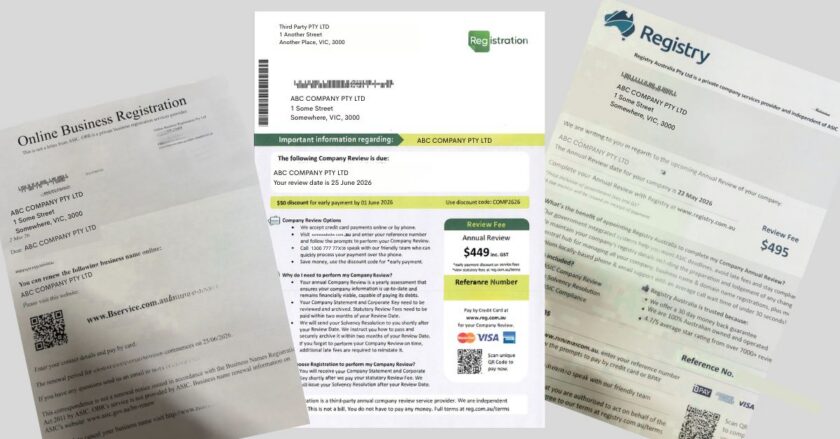
Have you received a company annual review notice that looks like an invoice or urgent payment request?
We’ve seen examples received by both Morrows team members and many clients – and importantly, ASIC has now formally issued a public alert (22 May 2026), reinforcing that businesses should remain cautious of unsolicited third-party notices.
These communications may appear official or resemble ASIC correspondence, however they are not issued by ASIC, and businesses are not required to use these third-party services.
Read ASIC’s announcement here:
Unsolicited business name renewal and company review notices
In some cases, the timing of these notices closely aligns with your company’s actual annual review date, making them even harder to distinguish from official correspondence.
The key point is simple:
Some company directors and business owners are receiving formal-looking letters offering to complete or facilitate their company’s annual review.
These notices can appear official and may include:
- reference numbers
- payment options and card logos
- QR codes
- “early payment discounts”
- wording that resembles a government compliance notice
In some cases, the letters arrive close to the company’s annual review date, making them easy to mistake for an official ASIC invoice.
The key thing to know
These notices are generally lawful third-party commercial offers, however businesses should carefully review the sender, services offered and fees before making payment
It’s important to remember that they are not ASIC invoices, and businesses are not required to use the third-party provider.
How the ASIC annual review process normally works
Every Australian company must complete an annual review.
ASIC issues an annual statement that includes:
- the annual review fee invoice
- the company details currently recorded by ASIC
- any actions required by the company
Companies must then:
- pay the ASIC annual review fee
- review and confirm company details
- pass a solvency resolution where required
Where Morrows is appointed as the company’s registered agent, ASIC will generally send the annual statement directly to us first. We then coordinate the annual review process as part of our company compliance services.
ASIC notes that annual statements are sent to only one address, with the registered agent’s (such as Morrows) address taking priority if a registered agent has been appointed.
Why these notices can be confusing
The notices we have seen are not necessarily a sign that any Morrows systems or client records have been compromised.
Company information is publicly available through ASIC company searches and registers, which means third parties can legally obtain company details and contact directors or registered offices.
However, these notices may still cause confusion because they often resemble official government correspondence.
They may also request payment amounts exceeding the standard ASIC annual review fee.
For example:
- ASIC’s current annual review fee for a standard proprietary company is $329
- ASIC’s current fee for certain special-purpose companies, including many SMSF trustee companies, is $67
- ASIC fees do not include GST
Some third-party notices may request significantly higher amounts and refer to additional service fees or GST.
ASIC warning signs to watch for
ASIC has highlighted several common features of these notices, including:
- Documents that look like invoices when payment is not actually required
- Requests for payment well before a due date
- Urgent language or “discounted” offers
- Fees that include additional service charges without clearly separating ASIC fees
What should you do if you receive one?
Instead:
- Check who issued the notice
- Avoid scanning QR codes or using payment links if you are unsure
- Forward the notice to your Morrows adviser or company secretarial contact for review
- Wait for Morrows correspondence if we manage your ASIC compliance obligations
- ASIC also recommends to log into ASIC directly (via ASIC Connect or your portal) to confirm whether anything is actually due.
Morrows’ recommendation
If Morrows manages your company annual review process, please wait for our correspondence before making any payment.
A simple rule
If in doubt, check with Morrows before you pay.
Related Posts
5 Tips on preparing for your SMSF annual accounts and audit
The end of the financial year can be a busy time for SMSF trustees. Having the right information ready can

Own a Property Bought Before 20 September 1985? What the 2027 CGT Changes Mean for You
If you own a property that was purchased before 20 September 1985, you may have assumed it would always be